Introduction
Maintenance is an essential part of running a reliable business. Equipment, electrical systems, air conditioning, plumbing, machinery, and other facilities require regular attention to operate properly. However, businesses have different ways of managing their maintenance requirements.
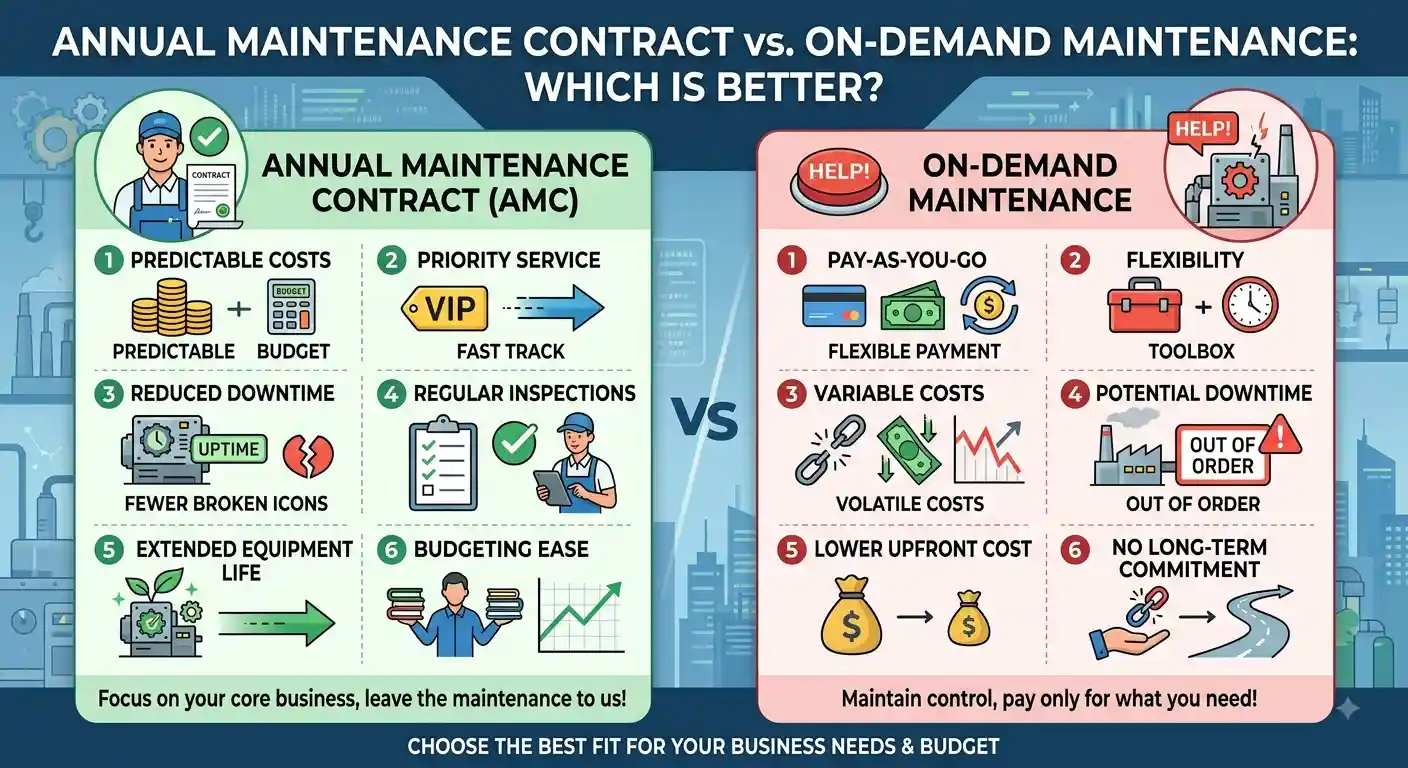
Two common approaches are an Annual Maintenance Contract (AMC) and on-demand maintenance. With an AMC, a business enters into an ongoing agreement with a maintenance provider for scheduled services and support. With on-demand maintenance, the business contacts a technician only when a maintenance problem occurs.
Both approaches have advantages and limitations. The right choice depends on the type of equipment, frequency of maintenance, operational requirements, budget, and potential impact of equipment failure.
What Is an Annual Maintenance Contract?
An annual maintenance contract is a service agreement between a business and a maintenance company for a defined period, usually one year.
The agreement outlines the equipment or systems covered, maintenance schedule, services provided, response times, and pricing.
Depending on the contract, services may include preventive maintenance, routine inspections, cleaning, testing, troubleshooting, minor repairs, and technical assistance.

Some comprehensive agreements may also include emergency support or priority service.
The main purpose of an AMC is to create a planned and consistent maintenance strategy rather than relying entirely on emergency repairs.
What Is On-Demand Maintenance?
On-demand maintenance is a reactive maintenance approach. Instead of maintaining equipment according to a long-term service agreement, the customer contacts a maintenance provider whenever a problem occurs.
For example, if an air conditioning unit stops working, the business contacts a technician to diagnose and repair the issue.
This approach can be suitable for businesses with limited maintenance requirements or equipment that does not require frequent professional servicing.
However, relying entirely on on-demand maintenance can become challenging when equipment develops frequent problems or when unexpected failures cause significant downtime.
How Do the Two Approaches Differ?
The biggest difference is the way maintenance is planned.
An annual maintenance contract focuses on scheduled and preventive maintenance. Technicians regularly inspect equipment and identify potential problems.
On-demand maintenance focuses primarily on responding to problems after they occur.
This distinction can have a significant effect on equipment reliability, maintenance planning, and long-term costs.
Cost Comparison
Cost is an important consideration when choosing between an AMC and on-demand maintenance.
With an annual maintenance contract, businesses generally agree to a predefined service arrangement. This can make routine maintenance expenses more predictable.
On-demand maintenance does not require a long-term contract, but individual service calls can vary in cost. Emergency repairs may also involve additional charges.
For businesses that require frequent maintenance, repeated on-demand service calls may eventually cost more than a structured annual contract.
However, businesses with very limited maintenance requirements may find on-demand service more economical.
Preventive vs. Reactive Maintenance
An AMC is generally associated with preventive maintenance. Scheduled inspections allow technicians to identify potential problems before they become major failures.
On-demand maintenance is generally reactive because service is requested after a fault occurs.
Preventive maintenance can be particularly valuable for equipment that is essential to business operations.
By identifying problems earlier, businesses may be able to avoid more expensive repairs and reduce unexpected downtime.
Equipment Reliability
Regular maintenance can contribute to better equipment reliability.
Under an AMC, technicians visit according to a planned schedule and monitor equipment condition over time.
With on-demand maintenance, equipment may receive no professional attention until a problem becomes noticeable.
For frequently used or critical equipment, the continuous maintenance approach provided by an AMC can offer greater reliability.
Business Downtime
Downtime can affect productivity, customer service, and revenue.
When equipment suddenly fails, an on-demand maintenance customer must first locate a service provider and arrange a repair. Depending on the provider’s availability, the response may take time.
An AMC can provide an established maintenance relationship. Depending on the contract, customers may have access to defined response times or priority service.
This can make an AMC particularly useful for businesses where equipment downtime has a significant operational impact.
Maintenance Planning
An annual maintenance contract provides a structured schedule for inspections and servicing.
Businesses can plan maintenance visits around their operating schedules and avoid leaving important service tasks until a problem occurs.
On-demand maintenance provides greater flexibility because the business only pays for service when needed. However, this flexibility can also mean that routine maintenance is overlooked.
Equipment Lifespan
Regular maintenance can help protect equipment from excessive wear and premature deterioration.
An AMC encourages consistent servicing and inspection, which can support long-term equipment performance.
With on-demand maintenance, equipment may receive attention only when something goes wrong. If minor problems remain unnoticed for extended periods, they can potentially contribute to more serious damage.
Access to Technical Support
Businesses with an AMC typically have an established relationship with a maintenance provider.
This can make it easier to contact technicians and request support when a problem occurs.
On-demand customers may need to search for an available technician each time they experience a problem.
For businesses that depend on specialized equipment, having an established technical support relationship can be particularly beneficial.
Flexibility
One advantage of on-demand maintenance is flexibility.
A business does not necessarily need to commit to a long-term contract. It can choose when to request service based on immediate requirements.
An AMC involves a longer commitment, but it provides a structured maintenance schedule and ongoing support.
Businesses should therefore consider whether they value maximum flexibility or prefer predictable, planned maintenance.
Which Option Is Better for Small Businesses?
Small businesses with limited equipment and low maintenance requirements may find on-demand maintenance suitable.
However, if the business relies on critical equipment or operates systems that require regular servicing, an AMC may provide greater value.
The decision should be based on the potential consequences of equipment failure rather than business size alone.
A small company can still experience significant losses if an essential system stops working.
Which Option Is Better for Large Businesses?
Large businesses, commercial properties, factories, hotels, warehouses, and organizations with multiple systems may benefit significantly from an annual maintenance contract.
Managing numerous maintenance requirements through individual service calls can become time-consuming.
An AMC can provide a centralized and structured approach to maintenance, making it easier to schedule inspections and manage technical support.
When Should You Choose an Annual Maintenance Contract?
An AMC may be the better option when equipment requires regular maintenance or when unexpected breakdowns could significantly affect operations.
It can also be useful when a business owns expensive equipment that needs professional servicing to remain reliable.
Businesses that want predictable maintenance expenses and an established technical support relationship may also prefer an AMC.
When Is On-Demand Maintenance Suitable?
On-demand maintenance can be appropriate when equipment is used infrequently or maintenance requirements are relatively low.
It may also be suitable for businesses that do not want to commit to a long-term service agreement.
However, customers should still ensure that essential equipment receives appropriate preventive maintenance even if they do not have an AMC.
How to Make the Right Decision
The best maintenance strategy depends on the specific needs of each business.
Companies should evaluate equipment value, maintenance frequency, operating conditions, potential downtime costs, repair history, and available budget.
It is also useful to compare the estimated annual cost of on-demand repairs with the price and coverage of an AMC.
This comparison can provide a clearer picture of which approach offers better long-term value.
Final Thoughts
Both an Annual Maintenance Contract and on-demand maintenance can be useful depending on business requirements.
On-demand maintenance provides flexibility and may be suitable for businesses with limited service needs. An annual maintenance contract, on the other hand, provides a structured approach that combines scheduled servicing with ongoing technical support.
For businesses that depend heavily on equipment and cannot afford frequent downtime, an AMC may provide greater reliability, better maintenance planning, and more predictable costs.
Ultimately, businesses should choose the approach that matches their equipment, operational risks, maintenance requirements, and long-term objectives.
Related Reading: Holiday Home Management: How Professionals Help Maximize Returns