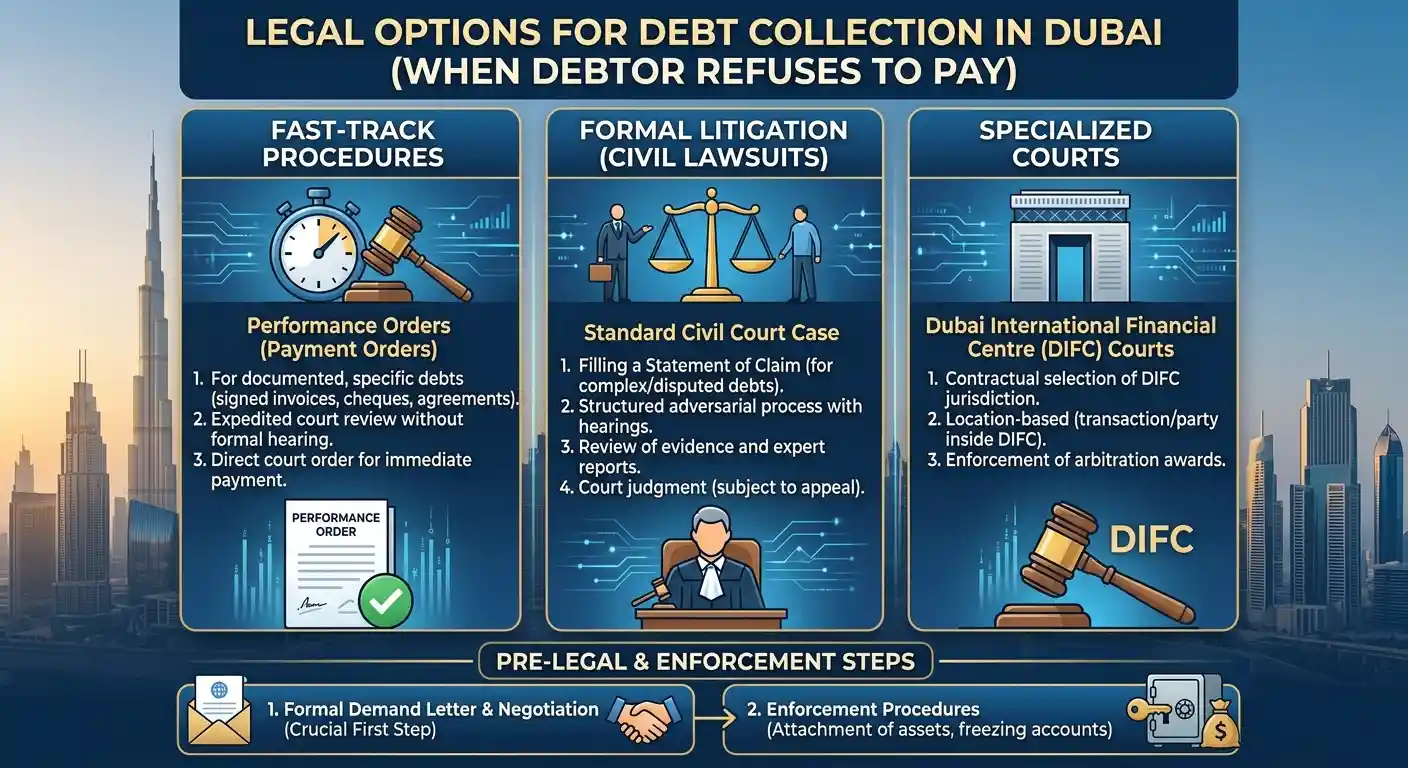
When a debtor refuses to pay an outstanding amount, creditors may face financial pressure, disrupted business operations, and uncertainty about how to recover their money. The situation can become more complicated when repeated reminders are ignored, the debtor disputes the agreement, or a previously promised repayment never occurs. Understanding the available legal options helps individuals and businesses decide how to proceed while protecting their rights under the applicable UAE legal framework.
Debt collection Dubai matters may be resolved through direct negotiation, formal payment demands, settlement agreements, or appropriate legal proceedings. The most suitable option depends on the nature of the debt, the contractual documents, the amount outstanding, and the debtor’s response.
Creditors should avoid assuming that every unpaid debt requires immediate litigation. A careful review of the evidence and the available remedies can help determine the most practical and proportionate course of action.
Why Might a Debtor Refuse to Pay an Outstanding Debt?
A debtor may refuse payment for several reasons. Understanding the underlying issue is important because it can affect the creditor’s recovery strategy.
Some debtors experience financial difficulties and cannot meet their obligations when payment becomes due. Others may dispute the amount claimed, allege that contractual work was incomplete, or argue that the creditor failed to fulfil an agreed obligation.
In other situations, the debtor may acknowledge the outstanding amount but repeatedly delay payment without providing a realistic repayment plan.

Common warning signs include:
- Ignoring payment reminders and formal correspondence.
- Repeatedly promising payment without meeting deadlines.
- Disputing an invoice without providing supporting evidence.
- Refusing to acknowledge an established contractual obligation.
- Failing to comply with an agreed repayment arrangement.
- Providing inconsistent explanations for continued non-payment.
Creditors should document these developments and distinguish genuine disputes from apparent attempts to avoid payment. A debtor’s refusal alone does not automatically establish liability, so the underlying agreement and supporting evidence remain important.
What Should Creditors Do Before Taking Legal Action?
Before commencing legal proceedings, creditors should review the debt carefully and establish whether the claim is supported by reliable evidence.
The first step is to examine the agreement or other document that establishes the payment obligation. This may include a commercial contract, loan agreement, invoice supported by transaction records, or another relevant document.
Next, calculate the outstanding balance and account for previous payments, credit notes, agreed deductions, and any disputed amounts.
Creditors should also collect evidence showing that the relevant goods were delivered, services were completed, or contractual conditions were satisfied. Correspondence in which the debtor acknowledges the debt or promises repayment may also be relevant.
The creditor should then review any applicable contractual requirements concerning payment notices, dispute resolution, jurisdiction, and deadlines.
Where the claim involves substantial sums, complicated contractual arrangements, or a debtor based outside the UAE, obtaining legal advice before taking further action may help identify potential risks.
Can a Formal Payment Demand Help Recover the Debt?
A formal payment demand can be an important step when informal reminders have failed. It provides a clear record of the creditor’s position and gives the debtor an opportunity to resolve the outstanding amount.
A well-prepared demand generally identifies the parties, describes the transaction, specifies the outstanding amount, refers to relevant contractual terms, and states the requested payment deadline.
It may also explain the potential next steps if the debt remains unpaid, provided those steps are described accurately and lawfully.
The required form, service method, and legal effect of a demand depend on the circumstances and applicable procedural rules. Some matters may require a particular notice or service method, while others may not.
Creditors should therefore avoid relying on a generic demand letter when a specific legal procedure applies. A lawyer can assess the relevant requirements and help prepare appropriate correspondence.
What Legal Proceedings Can Be Used to Recover a Debt in Dubai?
If negotiations and payment demands do not resolve the matter, a creditor may consider formal legal proceedings.
The appropriate procedure depends on the type of debt, the evidence available, the parties involved, and the court or authority with jurisdiction.
Depending on the circumstances, the creditor may need to pursue an ordinary civil or commercial claim or assess whether a specific procedure is available under the applicable rules.
A legal professional can review the claim and help determine:
- Which court or forum may have jurisdiction.
- What documents and evidence are required.
- Whether a contractual notice must be issued first.
- What filing fees and other expenses may apply.
- Whether the claim is disputed or supported by sufficient documentation.
- What remedies may be available if the creditor succeeds.
The existence of an unpaid invoice does not automatically guarantee a successful judgment. The creditor must establish the legal basis of the claim and satisfy the relevant evidential and procedural requirements.
Businesses should also consider whether the likely recovery justifies the cost and time involved in litigation.
Can Creditors Recover Debts Through Negotiation Instead of Court?
Yes. Negotiation can provide a practical alternative when the parties are willing to discuss repayment.
A creditor may agree to instalments, a settlement amount, or another arrangement that provides a realistic prospect of recovering the money. This can be particularly useful where the debtor acknowledges the debt but faces temporary cash-flow difficulties.
However, a repayment proposal should be assessed carefully. Creditors should consider the debtor’s payment history, the amount outstanding, the proposed schedule, and the consequences of another default.
Any settlement should be recorded in writing and should identify the total amount payable, instalment dates, payment method, and consequences of missed payments.
The agreement should also clarify whether the original debt remains in force, whether any part of the claim is being waived, and what happens if the debtor fails to comply.
Where significant sums or disputed legal rights are involved, professional advice can help ensure that the settlement is properly documented.
What Evidence Is Needed for a Debt Collection Dubai Claim?
Evidence is essential when a debtor disputes an obligation or refuses to pay. Creditors should organize documents that establish the origin, amount, and due date of the debt.
Important records may include:
Contracts and agreements: These show the parties’ obligations, payment terms, and relevant contractual conditions.
Invoices and account statements: These identify the amount claimed and help establish the outstanding balance.
Proof of delivery or performance: Delivery notes, completion certificates, acceptance records, and related documents may demonstrate that the creditor fulfilled its obligations.
Payment records: Bank statements, receipts, and accounting records can establish payments received and amounts remaining unpaid.
Correspondence: Emails, letters, and messages may show acknowledgements of the debt, payment promises, or disputes raised by the debtor.
Repayment agreements: Written settlement terms can help establish an agreed payment schedule or revised obligation.
The evidence should be consistent, complete, and relevant to the claim. If documents were created overseas or in another language, translation or authentication may be required for a particular proceeding.
How Can a Notary Public Dubai Assist With Debt-Related Documents?
A Notary public Dubai service may assist with certain eligible document formalities connected with a commercial or personal debt. However, notarization is not a substitute for debt recovery or legal representation.
Depending on the document and the applicable requirements, notarial services may be relevant to specific declarations, signatures, or other documents that fall within the authorised notarial function.
For example, a creditor may need an eligible document formally executed for a related transaction or for presentation to an authority in another jurisdiction. The appropriate procedure depends on the document’s purpose and the requirements of the receiving authority.
It is important to understand that notarizing a declaration about an outstanding amount does not automatically prove that the debt is valid or enforceable. The creditor may still need to provide the underlying agreement, invoices, proof of performance, and other supporting evidence.
A notary does not independently determine liability, issue a court judgment, or guarantee that a debtor will pay.
Before arranging notarization, creditors should confirm whether the document requires a notarial act or a different procedure, such as certification, translation, or attestation.
What Happens if a Creditor Obtains a Court Judgment?
Obtaining a judgment may establish the creditor’s legal entitlement to recover an amount, but it does not necessarily mean payment will occur immediately.
If the debtor does not comply voluntarily, the creditor may need to consider the applicable enforcement procedure. The available steps depend on the judgment, the relevant court rules, and the circumstances of the debtor and any assets involved.
Creditors should understand that enforcement is distinct from the original court proceedings. Additional applications, documentation, fees, or procedural steps may be necessary.
The practical prospects of recovery can also depend on the debtor’s financial circumstances and the availability of assets against which enforcement is legally possible.
A qualified legal professional can explain the relevant enforcement options and help the creditor understand the likely requirements. Creditors should not assume that every enforcement measure is available in every case.
What Challenges Can Affect Debt Recovery?
Several issues may complicate a recovery claim.
A debtor may dispute the amount, allege that the creditor failed to perform contractual obligations, or raise a counterclaim. Missing documents, inconsistent accounting records, and unclear payment conditions can also weaken a creditor’s position.
International transactions may raise additional questions about jurisdiction, governing law, service of documents, and enforcement across borders.
Another important consideration is timing. Applicable limitation periods and procedural deadlines can affect a creditor’s options. The relevant rules depend on the nature of the claim, so creditors should seek advice rather than assume that an old debt can always be pursued.
A careful review of the legal and factual circumstances can help identify obstacles before additional time and money are spent on recovery action.
How Can Creditors Improve Their Chances of Recovering Outstanding Debts?
Creditors can take several practical steps to manage unpaid debts more effectively.
First, maintain written agreements that clearly establish payment terms and contractual responsibilities.
Second, issue accurate invoices and retain evidence of delivery, completion, and customer acceptance.
Third, monitor overdue accounts and follow up promptly when payment deadlines are missed.
Fourth, keep records of all communications, payment promises, and settlement discussions.
Fifth, investigate genuine disputes and correct any errors before escalating the matter.
Finally, obtain appropriate legal advice when a debtor refuses to pay, ignores formal demands, or repeatedly breaches repayment arrangements.
These measures cannot guarantee recovery, but they can help creditors assess their options and present a better-documented claim when formal action becomes necessary.
Conclusion
When a debtor refuses to pay, creditors may have several options, including negotiation, formal payment demands, settlement agreements, and legal proceedings. The right approach depends on the nature of the obligation, the supporting evidence, the debtor’s response, and the applicable UAE legal framework.
Debt collection Dubai matters should be handled through accurate documentation, professional communication, and proportionate recovery measures. A Notary public Dubai service may assist with specific document formalities where required, but notarization alone does not establish liability or guarantee payment.
By reviewing the debt carefully, acting within applicable deadlines, and obtaining appropriate legal advice, creditors can make more informed decisions and pursue available remedies while protecting their commercial interests.